
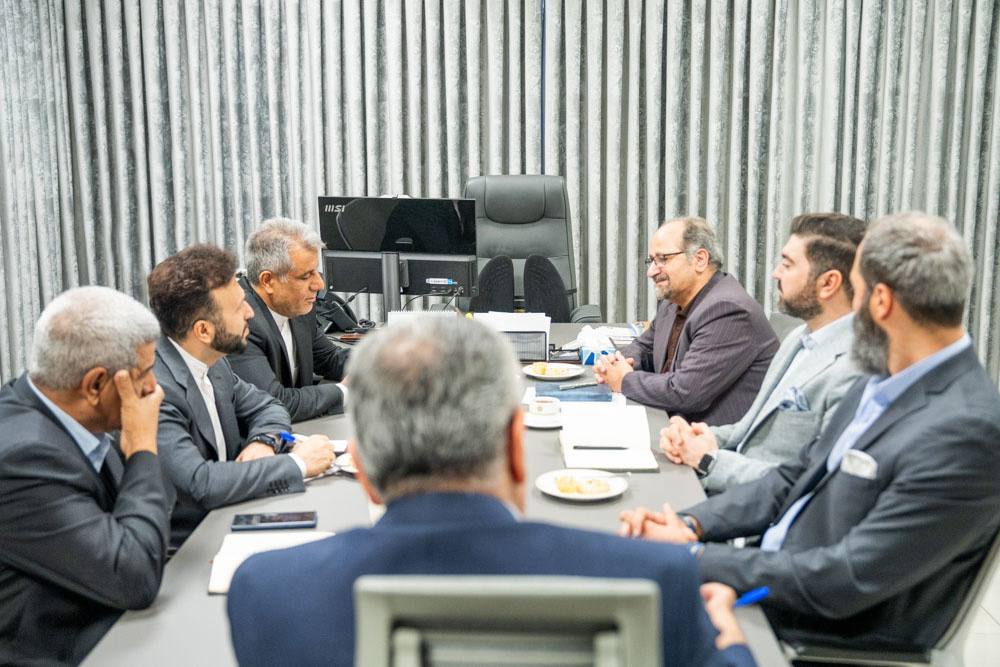
The recent meeting between Iran's new ambassador to South Korea, Ahmad Erfanian, and Tehran Chamber of Commerce Secretary-General Fereydoun Vardinejad was undeniably constructive in tone. Before even setting foot in Seoul, the ambassador chose to engage directly with the private sector—a pragmatic move that deserves recognition.
Yet, if we are to speak honestly about the path ahead, we must first clear the air of nostalgia. The $17 billion trade figure from 2011 is not a forgotten milestone waiting to be reclaimed; it is a number from a fundamentally different geopolitical era. Under the current weight of US secondary sanctions, returning to that level is, for all practical purposes, out of reach.
This is not pessimism; it is a reality that both Iranian traders and Korean conglomerates confront daily. South Korea's economy remains deeply integrated with the United States, and for Korean giants like Samsung, Hyundai, and LG, compliance with Washington's sanctions regime is not optional—it is existential. No number of well-intentioned B2B meetings or specialized webinars can circumvent the SWIFT banking blockade or the legal risks that terrify Korean boardrooms. Ambassador Erfanian acknowledged as much when he noted the decline in trade figures, but the key takeaway is that this decline is structural, not cyclical.
That said, the meeting offered a realistic blueprint for what can be done—provided we lower our expectations and focus on the achievable. The sectors identified by the Tehran Chamber—medical equipment, pharmaceuticals, digital economy, and knowledge transfer—are smart choices. These are areas where the sanctions impact is slightly less crushing, often involving humanitarian exemptions or smaller-scale transactions that fly under the radar of US enforcement.
Vardinejad's admiration for Korea's brand-building and cultural resilience is well-placed, and Iranian businesses can genuinely learn from that experience. However, the learning will happen through modest channels—online seminars, academic exchanges, and targeted trade delegations—rather than through massive investment flows or joint ventures.
The practical suggestions put forward—creating a legal and regulatory database, establishing direct communication channels between chambers, and engaging economic think tanks—are precisely the kind of low-cost, high-value measures that can keep the relationship alive without overpromising. These steps do not require billions in credit lines or complex financial instruments. They require patience, information-sharing, and the willingness to maintain a commercial dialogue even when the transactional payoff is small.
Addressing the same meeting, Pooya Firoozi, Vice President of the Iran-Korea Joint Chamber of Commerce, emphasized a development plan centered on economic resilience; which is perhaps the most honest framing of all. Resilience, in this context, means surviving the sanctions era with some commercial ties intact, rather than waiting helplessly for a diplomatic breakthrough. The goal is not to return to 2011; the goal is to avoid a complete collapse to zero, preserving a channel that can be expanded if and when political conditions eventually shift.
Ultimately, this meeting was a useful exercise in pragmatic adaptation. Ambassador Erfanian and the Tehran Chamber are right to keep talking, to keep planning, and to keep the door open. But let us not dress this up as a grand revival. The railway between Tehran and Seoul is not being rebuilt for high-speed freight; it is being maintained as a narrow gauge for specialized, low-volume cargo. That is not a failure—it is a realistic strategy for a difficult period. And in today's climate, keeping even that narrow track operational is a victory worth acknowledging.