
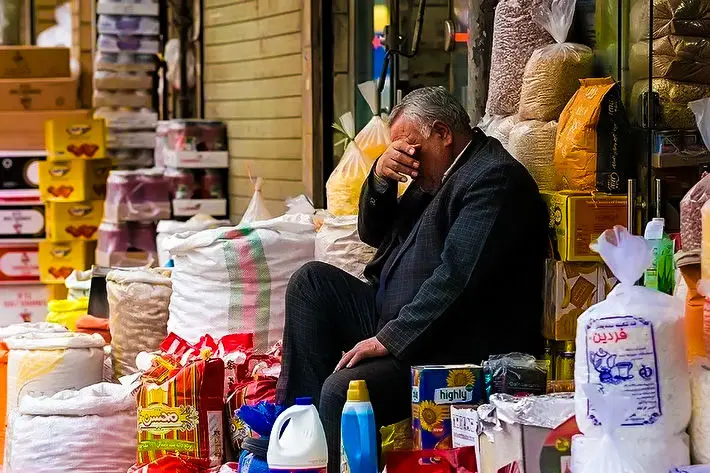
Despite visible fluctuations in Iran’s headline inflation over the past two years, core inflation indicators suggest that underlying price pressures remain firmly entrenched across the economy.
A recent assessment by the Monetary and Banking Research Institute (MBRI) indicates that temporary declines in headline inflation have largely reflected short-term controls over volatile items rather than a durable easing of inflationary forces.
Between Farvardin 1403 and Shahrivar 1404 (March 2024–September 2025), point-to-point inflation hovered around the 40% mark, occasionally giving rise to optimism that inflationary momentum was weakening.
However, a closer look at various core inflation measures paints a more complex and less reassuring picture. These indicators show that inflation has become broad-based, sticky and increasingly structural in nature.
According to Central Bank of Iran data, point-to-point inflation reached 43.9% in Shahrivar 1404, rising by 2.5 percentage points from the previous month. While inflation was somewhat lower at the beginning of 1403, it has not fallen below 40% at any point in 1404.
This persistence is notable given the authorities’ emphasis on liquidity control and monetary tightening, suggesting that existing policies have so far failed to push inflation out of the high-inflation regime.
Telling Evidence
Core inflation based on the weighted median provides particularly telling evidence. This indicator, which focuses on the center of the distribution of price changes rather than extremes, stood at 32.9% in Shahrivar 1404. It rose by 2 percentage points compared with Mordad (August 2025) and by 3.1 percentage points relative to the start of the year.
The roughly 11-percentage-point gap between headline inflation and the weighted median core measure implies that volatile items have amplified headline figures. Yet the steady upward movement of this core index confirms that inflationary pressure has spread well beyond a narrow set of goods.
A similar conclusion emerges from the trimmed mean core inflation measure, which excludes items with exceptionally high or low price changes.
Over most of the period under review, this indicator has closely tracked headline inflation. Such a pattern suggests that temporary shocks alone cannot explain the observed price dynamics; instead, inflation is being driven by endogenous and structural factors that permeate the broader economy.
Unlike temporary inflation, which tends to dissipate over time, generalized inflation spreads quickly and is far harder to contain.
Perhaps the strongest signal of persistence comes from exclusion-based core inflation, calculated by fully removing food and beverages.
Over the long period from 1396 to Shahrivar 1404 (2017–September 2025), average exclusion-based core inflation stood at 39.35%, compared with an average headline inflation rate of 34.12%. This indicates that in certain periods, administrative controls or short-term declines in food prices masked the true intensity of inflation in other sectors.
While food price interventions may temporarily lower headline inflation, they do not necessarily reduce inflationary pressure across the economy.
Volatility measures further reinforce this assessment. The standard deviation of point-to-point headline inflation during the period was 15.67 percentage points, significantly higher than those of core inflation indicators, which ranged between 10.66 and 13.04 percentage points.
Defining Feature
This gap implies that shocks initially affecting volatile items have increasingly spilled over into more stable components of the consumption basket, transforming short-term disturbances into more persistent inflation.
The evidence suggests that declines in headline inflation should be interpreted with caution. Elevated core inflation—consistently above 30%—signals that inflationary pressures have become embedded in the economy.
From this perspective, reliance on short-term or sector-specific measures appears insufficient. Without addressing deeper structural drivers, high and sticky inflation is likely to remain a defining feature of Iran’s economic landscape.