
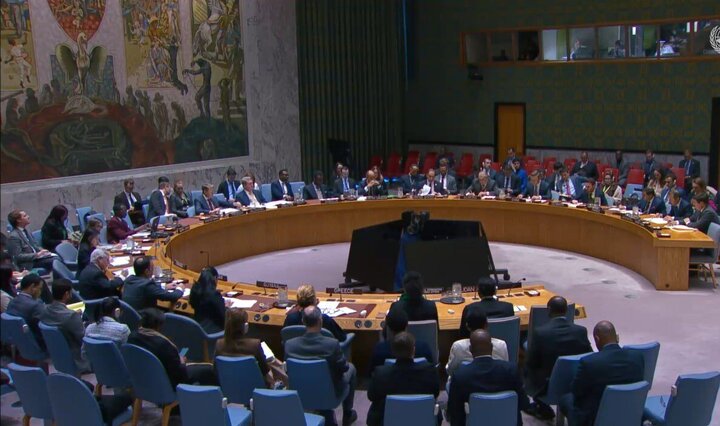
The United Nations Security Council convened a contentious session on Iran’s nuclear program despite objections from China and Russia, underscoring deep divisions among world powers.
At the meeting, US envoy Morgan Ortagus said Washington was prepared for direct negotiations with Tehran, but only on the basis of “zero enrichment.”
She stressed that no uranium enrichment inside Iran could be permitted under any future agreement.
“The United States remains available for formal talks, but only if Iran is ready for direct and meaningful dialogue,” Ortagus said, urging Tehran to “step back from the fire” and embrace diplomacy.
Iran’s ambassador Amir Saeid Iravani rejected the US condition, calling it incompatible with Iran’s rights under the nuclear Non-Proliferation Treaty (NPT).
“This approach shows that they are not seeking fair negotiations, but rather intend to impose their predetermined agendas on Iran,” he said, stressing that Iran will neither bow to pressure or intimidation, nor allow itself to be subjected to blackmail.
Iravani said Iran welcomed fair and meaningful negotiations but insisted that diplomacy would only be possible if the US and Europe changed course and took credible steps to rebuild trust.
The session was the first since European powers moved to trigger the snapback mechanism under Resolution 2231, restoring UN sanctions originally lifted under the 2015 nuclear deal (JCPOA). Resolution 2231 was set to expire on October 18, but France, Britain and Germany acted shortly before that date, a move denounced by China and Russia as illegal. Both countries later issued a joint letter with Iran declaring the resolution defunct and the issue of Iran’s non-proliferation obligations removed from the Council’s agenda.
Russia and China reiterated their opposition during the meeting, condemning the European initiative. Russia criticized Slovenia, the Council’s rotating president, for allowing the session to proceed. China argued that the European states had triggered the mechanism without first using the JCPOA’s dispute resolution mechanism.
Western representatives countered that the snapback was fully activated, meaning Resolution 2231 remains in force and Iran’s nuclear program must stay under review. Under the resolution, the Security Council is required to convene every six months, with the UN Secretary General submitting a report on the matter to the Council.
European envoys also accused Iran of blocking International Atomic Energy Agency inspections at nuclear sites damaged during the recent 12 day war with Israel and the United States. Russia responded that the restrictions were not imposed by Tehran but resulted from military strikes that destroyed key facilities.
In June, shortly before the sixth round of Iran-US talks, Israel attacked Iran and initiated a 12-day war that also saw the US bomb Iran’s three major nuclear facilities. Tehran later suspended cooperation with the International Atomic Energy Agency, although it later allowed inspections at sites that remained intact. Tehran, however, insisted that safety and security protocols must be established before the IAEA could enter the bombed facilities. Iranian officials argued that without such measures, inspections were not feasible.
The December 23 debate highlighted widening rifts within the Security Council. Unlike in past decades, members remain sharply divided over how to address Iran’s nuclear program, making a unified global response increasingly difficult.