
Neda Vahidi
In today’s Iran, where rising inflation steadily reshapes household budgets, fitness can feel like a luxury few can afford. Gym memberships in northern Tehran’s upscale neighborhoods now consume significant portions of a monthly salary, while even modest local gyms have raised fees beyond the reach of many families.
On top of that, commuting costs, sportswear, and nutritional supplements add further strain, creating a substantial economic barrier to regular exercise. For many young girls and women, particularly homemakers, attending a gym consistently is often not feasible.
Yet interest in fitness has not waned. Social media platforms such as Instagram, Telegram, and YouTube have quietly become Iran’s new fitness ecosystem—an accessible and affordable gateway to physical activity.
Through short clips, trainers demonstrate exercises that require minimal equipment, homemakers share their home routines, and young people document progress in small apartments or even basements. In a country where economic pressures limit access to formal facilities, these platforms have made fitness practical, relatable, and achievable.
Social media’s most powerful influence lies in its ability to create visual and relatable motivation. Users witness ordinary Iranians reaching fitness goals, joining challenges, and sharing their journeys. These success stories inspire a strong “I can do this too” response. Home workouts, exercises with children, modest sportswear, and even elderly women exercising have become normalized, breaking cultural taboos and integrating sport into everyday life.
New Opportunities
Economic constraints have also reshaped the fitness industry itself. Many female trainers, confronted with high overhead costs, have moved their businesses online. Online coaching, subscription-based programs, and the sale of home workout equipment allow them to reach wider audiences while generating income. This digital shift has created new opportunities for women, enabling financial independence and entrepreneurship, turning fitness into both a cultural and economic force.
Exercise has emerged as one of the most affordable ways to support mental well-being in a country where professional therapy is increasingly costly or difficult to access. While it cannot replace clinical care, physical activity offers a practical outlet for stress relief and restores a sense of personal control. Social media further amplifies this dynamic by circulating transformation narratives, group challenges, and forms of virtual community-building.
Striking Example
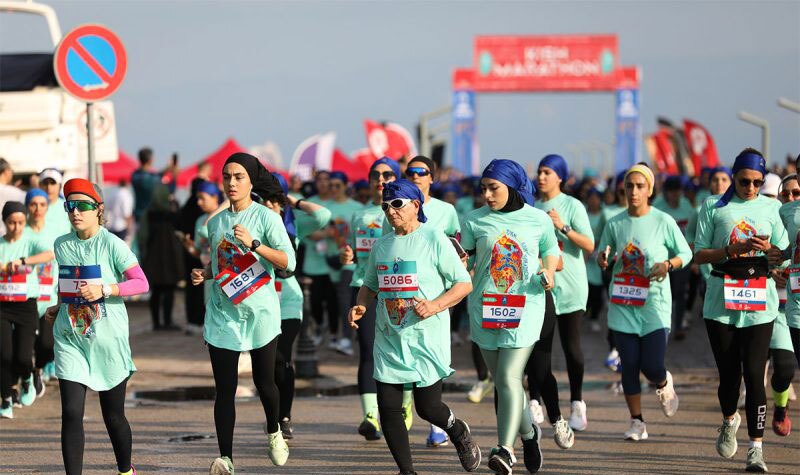
The Kish Marathon in December offers a striking example of social media’s transformative power. With over 5,000 participants, Iran’s only internationally registered marathon quickly drew nationwide attention when images and videos—especially of female runners—spread online.
The event sparked discussions about women’s participation, cultural norms, and public space. Social media not only promoted the marathon but also framed the conversation, demonstrating how a single event can influence both fitness culture and broader social dialogue.
Despite some controversy over decency and loose hijab among participants, the marathon reportedly inspired many Iranians to take up running and outdoor exercise, showing that even contentious events can boost public engagement in sport.
Grassroots Initiatives
Beyond formal events, grassroots fitness initiatives have flourished. Informal exercise groups meet in parks across Tehran, Isfahan, Shiraz, and smaller towns, often coordinated through Telegram channels or Instagram pages.
These gatherings provide community, routine, and motivation at little to no cost, blending online inspiration with offline action. In many cases, they offer an alternative to expensive gyms, particularly for middle- and lower-income households.
Nevertheless, a gap remains between aspiration and economic reality. Social media often portrays athletes using supplements, specialized equipment, and professional guidance that are financially out of reach for many. Protein powders, vitamins, and recovery products are costly in Iran, creating a divergence between the lifestyle shown online and what most people can realistically access. Yet low-cost alternatives, home workouts, and community-driven motivation continue to make fitness more inclusive than ever.
In this context—particularly within Iran’s evolving fitness landscape—social media has grown far beyond a mere entertainment platform. It now functions as a substitute gym, a public classroom, a business incubator, and a cultural stage—where women’s participation, lifestyle choices, and forms of communal engagement are actively reshaped.
These platforms provide an affordable and practical pathway to physical and mental health, as well as social connection. Fitness, in turn, is no longer a luxury; it has become a lived practice, a cultural conversation, and a crucial outlet for overall well-being.